
to have and not hold
often when we think of love, we see it as a currency of exchange, to be given and received. in reality, love is more like resonance—it’s an interaction between your natural frequency and another in the world. it’s fundamentally relational.
if love is the ultimate form of resonance, and resonance is antithetical to controllability, love and control exist at odds with each other. at the same time, because love is so essential, there is a natural desire for control. how could we be willing to leave that up to fate? but in the fantasy world where we could have total control over love, we would quickly find that love extinguished, choked in the viselike hold of our grasp. love requires a leap of faith, to be caught without knowing you will live through the fall. that’s why the phenomenon of the ai companion is so dangerous—they represent the desire for, above all, certainty. but there can be no love that’s absolutely certain because to love is to have the choice to not love.
as hartmut rosa writes in the uncontrollability of the world:
The fact that the other person could say “no” or “not now” is a precondition of being able to resonate with them at all. We cannot resonate with someone who always tells us we are right, who always encourages or shares our opinions and fulfills our every wish and desire (the dream of the “love robot”).
because of that, in order to love well, you have to accept—really, truly accept—that you will someday lose the people you love. we all will, eventually, to death or other circumstance. acceptance of loss allows you to meet others as they are, not as you need them to be. holding too tightly to an outcome—that you must have the people you love, forever—makes you rigid and fearful, unable to accept change and growth. paradoxically, learning to accept loss is what creates the circumstances for deep love.
the other week my friend surya told me how frustrating it’s been to date in new york. “everyone is living, like, a plotline. they’re in this sex and the city arc in their mind, and they just want to see if you’re going to be a good character who fits into their next episode.” it flattened his personhood into a list of collectable attributes; he was an npc in the main character’s show.
love, under this paradigm, becomes shopping. the buyer stays fixed, unmoving, evaluating potential purchases based on “fit.” this stance is intentional because it creates the illusion of power, a defensive shield against hurt. how embarrassing it is to be seen reaching; how humiliating it is to be willing to change for another person. better to be the judge, elevated and untouchable. but the self as consumer is structurally oppositional to resonance. in order to be met, to be surprised, you have to discard this mentality. as iris murdoch wrote in “the sublime and the good,” “love is the extremely difficult realisation that something other than oneself is real.”
i’ve come to view much of the discourse around “compatibility” as muddled. there is compatibility in the basic sense—the degree to which two people’s lives and worldviews and personalities align. this kind of compatibility measures the amount of effort it takes to reach each other and build a life together. it’s a property of the relationship.
but a lot of what we mean when we say “compatibility” is not just that. it’s closer to receptivity, each individual’s ability to experience resonance. how much of your capacity for love is dampened by fear? that shows up in many ways, like conflicts where your reflexive response overshadows your presence for another person, or moments where you want to express a feeling but withhold it out of lack of trust that it can be received.
it’s important to decouple the concept of receptivity from compatibility because compatibility turns love into a search problem. you’re constantly waiting for the right person to come into your orbit. but if your receptivity is low, even the most “compatible” person on earth is unlikely to suit you. this difference, between mutual compatibility and individual receptivity, typically shows up in recurring patterns. what echoes for the same person in relationship after relationship is rarely first and foremost a fit problem; it’s a need to expand their receptivity.
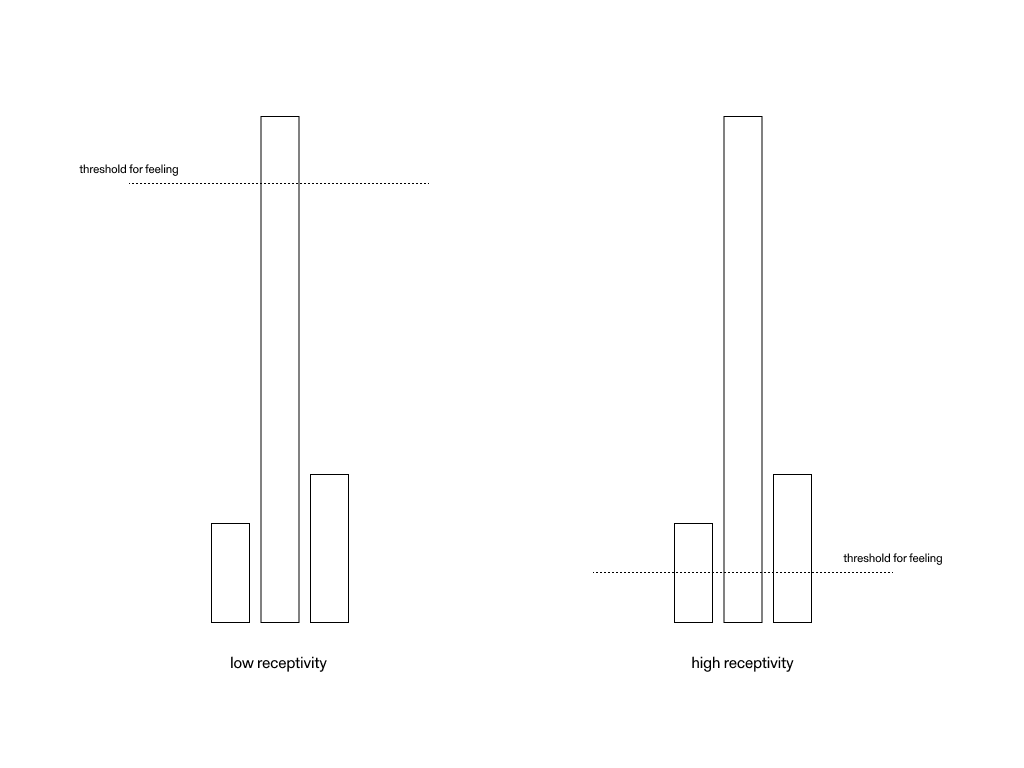
when receptivity is high, on-paper compatibility becomes less and less important, simply because you are less likely to read difference as a threat. it just is. if anything, it becomes a site of novelty and interest, something to learn. that’s what makes relationships viable over the long term, too. life is long; you will become many, many different iterations of yourself. a relationship built on initial compatibility but low receptivity will be rigid, lacking the fluidity to grow and reform over time as each person changes. but a relationship where both people have deepened their receptivity becomes one where each can continually expand.
receptivity is easily misread as accommodation. it’s not. anxious partners tend to view themselves as receptive to love because they’re willing to do anything to make a relationship work; avoidant partners are more apparently closed off. but anxious partners limit their receptivity, too, in their need for control—by bridging every gap, preempting every risk, limiting the possibility of true resonance that only lives in the unknowable. this issue is much easier to see from the outside, though it typically looks like a selection problem—this person keeps choosing people who aren’t well-suited to them. but that happens when the need for love is so great that they grasp at it too tightly for resonance to happen at all.
often we feel a scarcity of love that’s in fact a lower degree of receptivity. we think the problem is external to us: find the right people, the right life, and how we feel inside will change. and sometimes it does. but we are constantly surrounded by love in so many forms. the friend who dms you instagram reels, the stranger who holds the elevator door for you, the care in every aspect of the built world. it is possible to feel love in every moment, in each positive and negative emotion you experience. the work, then, is different. as helen schucman writes in a course in miracles (though usually misattributed to rumi), “your task is not to seek for love, but merely to seek and find all of the barriers within yourself that you have built against it.”
you have to love yourself before you can love someone else. like most aphorisms, i spent my whole life thinking it was trite and obvious, then suddenly realized i had never really understood it. originally i read it to mean that you need a base level of self-esteem to meet people as themselves, rather than reaching for them as avatars for your own worth.
but another layer of interpretation emerges when you read “love” as an action rather than a feeling, the act of deeply accepting a person in every way. in other words, you have to deeply accept yourself before you can deeply accept someone else.
most of us love ourselves in the sense that we feel love toward ourselves. much fewer of us accept ourselves for better and for worse. for my part, i am reluctant to accept my worst and best qualities because i fear complacency. the logic goes: if i accept that i am vain or thoughtful or selfish or creative or insecure or brilliant, i won’t want to grow anymore. i’m much more able and willing to accept these same qualities in others.
but, in practice, when you attempt to accept in others what you cannot accept in yourself, you create dissonance. for me, that manifested as a set of principles and rules to follow for others but not myself. i wanted to be loving, accepting, and understanding with the people who were important to me. but simultaneously i thought i needed to maintain “high standards,” be constantly dissatisfied with the status quo of who i was, or i would lose my motivation to be better. while that deeper belief remained, the loving orientation toward others was limited to surface-level behaviors that expended enormous effort because they clashed with my underlying worldview.
much of relational advice fails for this reason. frameworks for couples therapy and parenting advice and workplace conflict are usually premised on the idea that you can just change how you speak to other people. which is true, to an extent. but over time, if how you’re talking to others conflicts drastically with how you talk to yourself, it will feel like you’re contorting yourself beyond recognition, playing an elaborate game of pretend that becomes more and more tiring to sustain. with parenting, for instance, it is hard to help a child feel safe when you don’t feel safe; it is hard to be patient with a child when you’re not patient with yourself.
this knowledge can look like a dead end. when self-criticism feels like ground truth, you perceive unconditional love toward the self as illusory—a thin excuse to make you feel better about yourself, cope. it’s the participation trophy of existing. only love that you’ve rightly earned (through accomplishment, or goodness, or usefulness, or some other measure you’ve decided makes for an equal exchange) “counts.” or so you believe. but then when you experience it with others, you suddenly find yourself discounting it there, too. it’s not real because they’re not seeing the flaws i’m hiding. it’s not real because they’re better, or worse, than me, in some way that disqualifies their judgment. it’s not real because i haven’t done enough to earn it. the love that’s present is left unreceived.
what’s required is a perceptual shift. we tend to think of the objects of our love as the source of it, but that’s not quite right. all of the love you’ve ever experienced was generated through you, in your capacity to feel resonance, to see beauty and wonder and meaning somewhere and let yourself be changed by it. you already know how to love imperfection—ordinariness, frailty, inconsistency—not “in spite of” but “because of.” perhaps not in every moment, not toward everyone and everything, but it’s there, and it always has been.
the hard part is turning this gaze toward yourself, becoming receptive to yourself. your love is the one love that can be truly unconditional. you might find yourself resisting this statement; i do. it feels like a betrayal of the people i love to become self-sufficient in this way, a demotion of relationships from absolutely necessary to simply important. but it isn’t. it’s what makes your own choice to love real; it’s the only way to meet others freely.
to love well, you have to respect another person’s autonomy. to respect another person’s autonomy, you have to accept that they can leave you. to accept that a person you love can leave you, you have to trust that you can survive it. to trust you can survive it, you have to believe that love doesn’t come from somewhere else—your capacity for resonance is the source.
love is an exercise in continual surrender. only when you know at your core that every person you love can be lost to you, that you have no control over this fact, are you able to have them fully when they’re there. this truth is elusive when you’re young, when the course of your life runs smoothly, when you and everyone around you feels immortal. you have to learn and relearn it, again and again. but you cannot escape loss, and maybe each one wears down the barriers you’ve built some more.
as always, responses are my single favorite part about sharing to this newsletter, so if anything sparks a thought for you, i would love to hear it.
the whole world/reality is but a mirror - the perceiving is done on the inside.
everyone is on their own journey to the higher Self with their own timing and speed.
every tradition has some sort of "do unto others as you would have them do unto you" - i feel like they need to be amended to "highest you".
in that way if you treat others as if you would treat the highest possible you then they would in a sense mirror/reflect you back like two mirrors bouncing off each's reflection. but someone needs to first start it and it might as well be you. i call it the first bounce. also analogous to the tuning fork analogy.
the word "namaste" means "the Light in me recognizes and honors the Light in you"
i recently wrote something similar:
https://pilgrimsage.substack.com/p/the-mirror-that-says-nothing